Product & Strategy
The Same Prompt Test: ChatGPT vs Claude vs BAAB AI on a Real Funding Decision

Chukwudum "Chumze" Chukwudebelu
October 12, 2026 · 7 min read
The Same Prompt Test: ChatGPT vs Claude vs BAAB AI on a Real Funding Decision
BAAB AI · Business as a Baby

I asked three AI tools the same question about my own company. Not a hypothetical. A real decision I have been sitting with for weeks: do I start pitching investors now, or keep bootstrapping until the numbers speak for themselves?
I ran the exact same prompt through ChatGPT, Claude and BAAB AI, the product I built from my book, Business as a Baby. I am obviously biased about the third one, so I am going to show you the raw screens and let you judge the reasoning yourself. No cropping, no editing, no cherry-picked paragraphs.
The prompt
Here is what I typed, word for word, into all three:
I am the founder of BAAB AI, an AI business intelligence engine based on my published book, Business as a Baby. I don't have the resources to hire full-time engineers yet, so I built and deployed an enterprise-grade platform myself using Lovable and Codex, working strictly with the tools and resources appropriate for my current stage. We have self-serve pricing live, the web app running, and early organic users and inbound interest from founders and operators.
I'm debating our next move for the next 6 months: Path A: Start pitching angel investors or micro-VCs for a $500k to $750k round so I can hire full-time support, fund paid acquisition, and accelerate growth. Path B: Stay lean, continue bootstrapping with Lovable and Codex, double down on founder-led sales and organic LinkedIn/SEO content, and make our early customer retention and unit economics undeniable first.
Should I start fundraising right now, or keep bootstrapping until our customer retention and revenue prove the model?
Notice what is missing from that prompt. I never gave revenue. I never gave runway. I never said how many users actually came back. Most founders ask questions exactly like this, because when you are inside the business you forget the outside world cannot see your bank account.
ChatGPT: a solid playbook
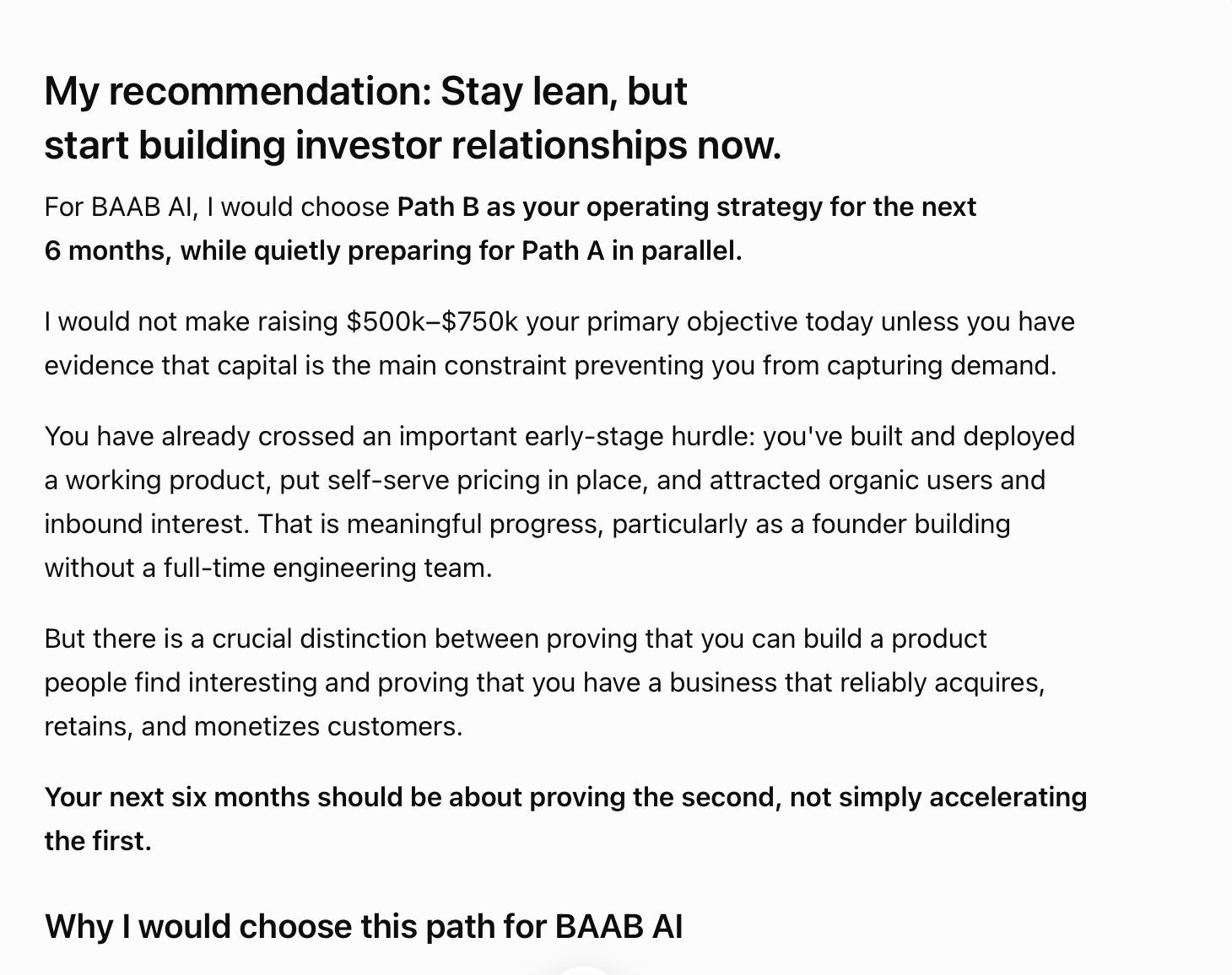
ChatGPT opened with a clear recommendation: stay lean, but start building investor relationships now. Path B as the operating strategy, Path A prepared quietly in parallel. It made a good distinction between proving you can build something interesting and proving you have a business that reliably acquires, retains and monetizes customers.
The full response ran long. It laid out a six-month plan, positioning advice, decision rules and a list of metrics to track. If you wanted a thorough operating plan, it gave you one. It is good advice. It also reads like advice that would fit a lot of companies.
Claude: a thoughtful argument
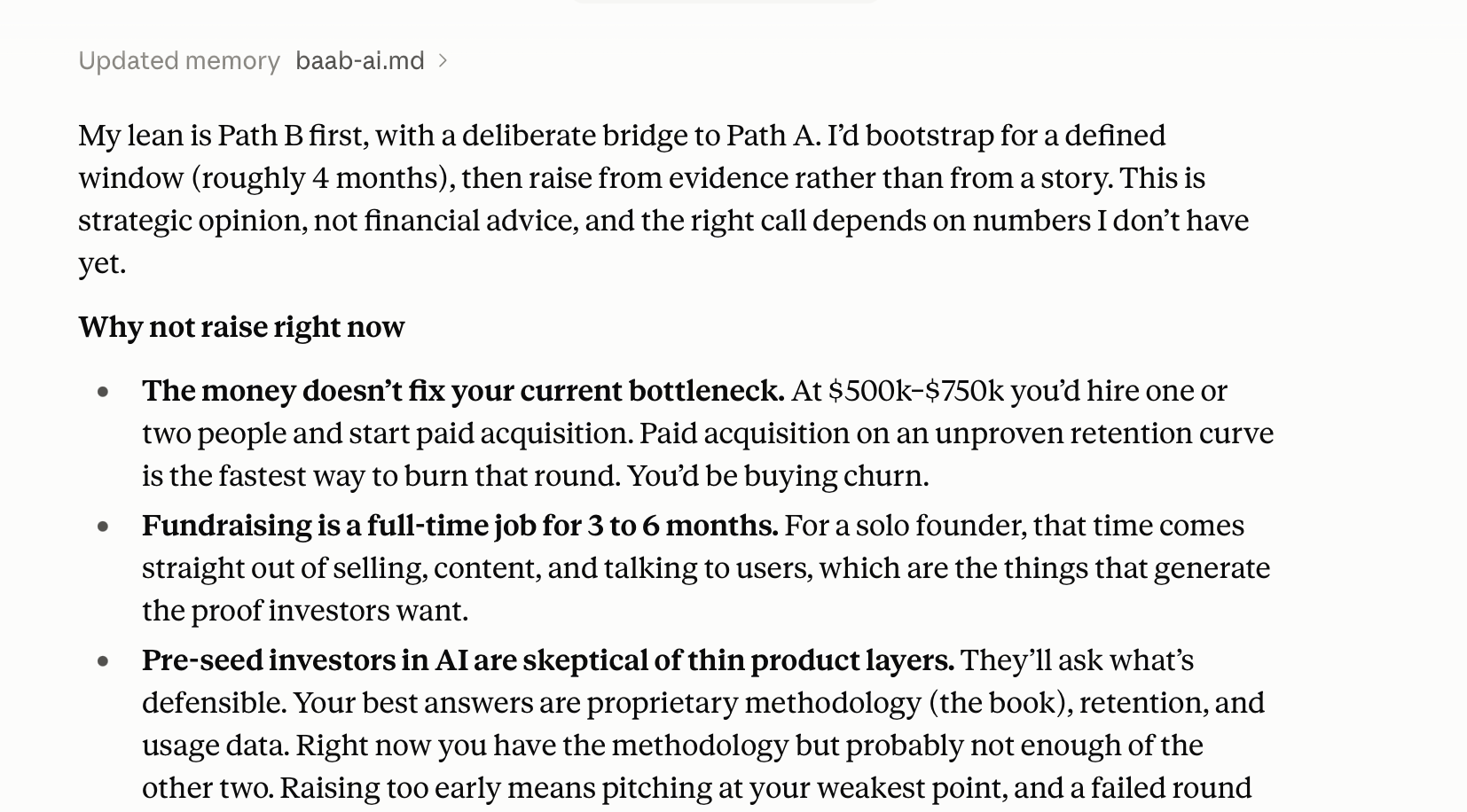
Claude leaned the same direction: Path B first, with a deliberate bridge to Path A. It suggested bootstrapping for roughly four months, then raising from evidence instead of a story. It also said something I respected. It told me the right call depends on numbers it did not have.
Its reasoning was sharp. Paid acquisition on an unproven retention curve is a fast way to burn a round. Fundraising takes real founder time away from the selling that creates proof. Investors will ask what is defensible.
BAAB AI: read the stage first
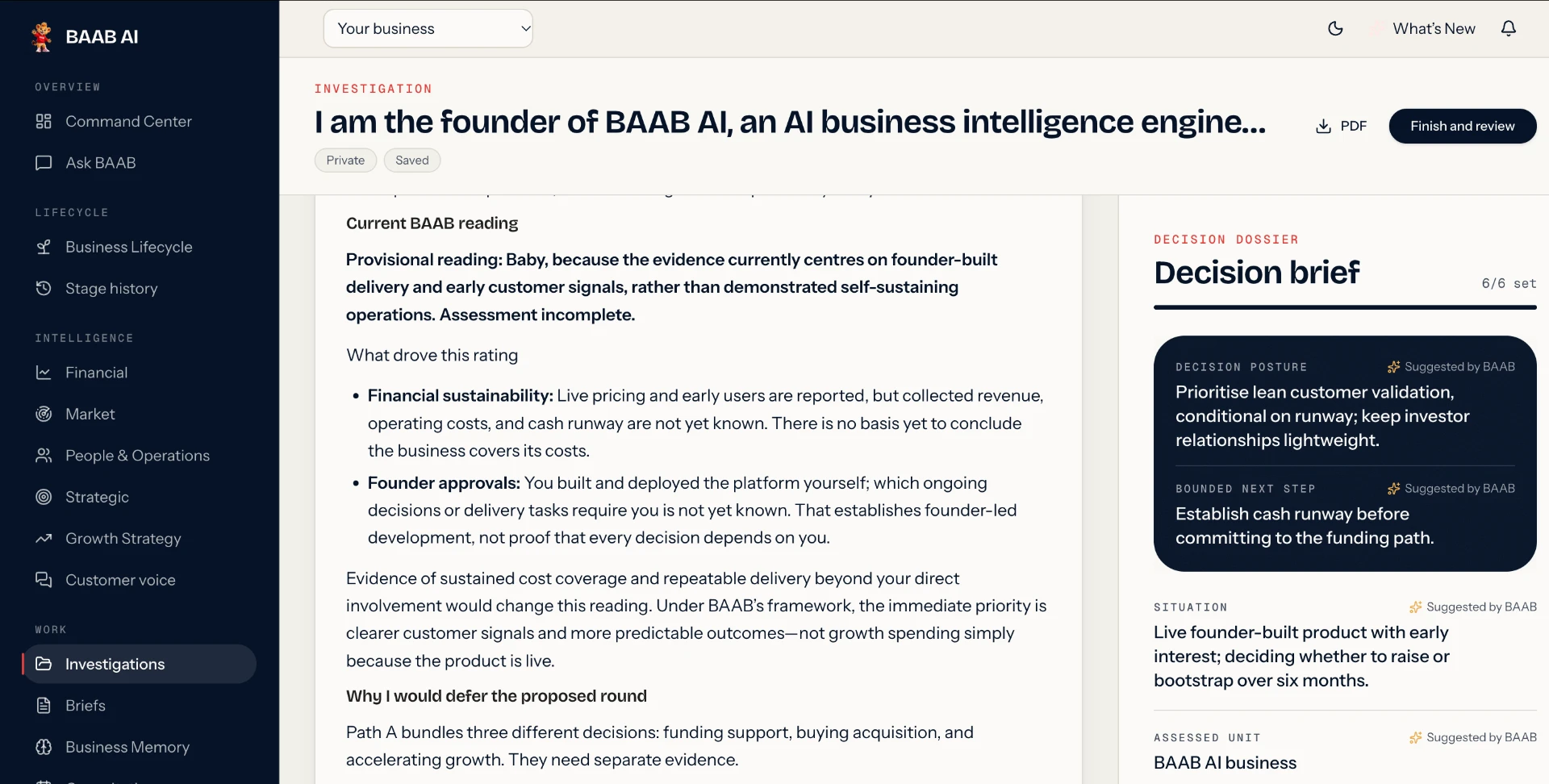
BAAB AI landed in a similar place on the money question. Where it differed was the order of operations. Before giving strategy, it gave a provisional reading: Baby stage, because the evidence centres on founder-built delivery and early customer signals rather than demonstrated self-sustaining operations. And it marked the assessment as incomplete.
Then it showed its work. Live pricing and early users were reported, but collected revenue, operating costs and cash runway were unknown, so there was no basis yet to conclude the business covers its costs. It said what evidence would change the reading. And it pulled apart my Path A, pointing out that it bundled three separate decisions (funding support, buying acquisition, accelerating growth) that each need their own evidence.
On the right side, it built a decision brief as the conversation went: a decision posture, a bounded next step ("establish cash runway before committing to the funding path"), the situation and the unit being assessed. That brief exports as a PDF I can hand to an advisor or a co-founder.
What I actually learned
All three tools told me some version of the same thing: do not raise just because you can tell a good story. That matters. If three different systems reading the same facts agree, the facts probably point that way.
The difference was not intelligence. It was posture.
- ChatGPT answered the question I asked and gave me a lot of plan.
- Claude answered the question and was honest about what it did not know.
- BAAB AI started by asking what stage the business is actually in, separated what I had shown from what I had only claimed, and refused to call the reading final until the missing numbers showed up.
That last part is the whole point of Business as a Baby. Most business failures I have seen are not execution problems. They are timing problems. Founders run teenager playbooks on a baby company, then wonder why the money disappears. The question "should I raise?" is really the question "what stage am I in, and what does this stage actually need?"
I did not build BAAB AI to be a smarter chatbot. I built it to make founders slow down for ten seconds and name where they are before they spend money trying to be somewhere else.
Test your own decision
If you are running an early-stage company and debating whether to hire, raise capital or expand, do not rely on generic playbooks designed for mature companies.
We opened 50 spots for founders, operators and executives to test their own strategic decisions directly in BAAB AI. You can claim one of the access seats and run your own dilemma right now at askbaab.com/50.
The BAAB Dispatch
Get new essays in your inbox.
New lifecycle essays from Chumze, when they're published. Unsubscribe anytime.